Bedroom
A Warm November Bedroom: One Textile Swap for Colder Nights
Colder nights do not need a new bedroom - one warmer top layer, a quilt folded at the foot and a wool throw are enough to sleep warm.
By Rae Bennett · · 7 min read
The first cold night always arrives without asking. One evening the bedroom is fine, and the next you wake at 3 a.m. too warm under the duvet, push it aside, and wake again at 4 a.m. cold. That cycle is not a sign you need a new bedroom or a heavier duvet. It is a sign the bed has only one setting, and one setting is never right all night.
This guide makes exactly one change: the top layer of the bed. The sheets stay, the pillows stay, and nothing new needs buying - the swap uses the bedding you already own, rearranged so you can add or remove warmth one layer at a time. It takes one evening, before Thanksgiving, nine days away on November 26.
Three distinctions first. Our November 8 guide to layering texture for November covered the whole house - sofa, bed, rug, every room. This is one room and one swap, about sleep and temperature, not styling. Our November 2 guide prepared a guest room for holiday visitors - a room for someone else. This is your own bedroom, and your own sleep. And our October 26 guide to small bedroom Christmas decor was Christmas styling. This is fall, with no Christmas decor, and the only thing being styled is the temperature of the bed.
Change only the top layer
The layer you feel most at night is the one on top, so that is the only one that changes. In summer it was probably a light percale cover or thin cotton coverlet, chosen to stay cool; in November that same layer is why the bed feels thin at midnight. Swap it for something brushed and warmer: a flannel duvet cover in brushed cotton, about five to six ounces, or a light quilt if you sleep warm and want only a little more weight. The rest of the bed stays as it was.
Flannel works because of the brushing, not the weight: the napped surface traps a thin layer of warm air, so it feels warm the moment you get in, without the heaviness of a thick duvet. A light quilt works the other way: thinner than a duvet, usually machine-washable, it folds back or pulls up without unmaking the bed. Either one is the swap; you do not need both.
If you sleep warm, change only this layer and leave the sheets alone: percale or linen underneath, warmth on top that you can push aside. If you sleep cold, you may swap the top sheet for flannel too, but try the top layer first for two nights - most people find the single swap is enough.
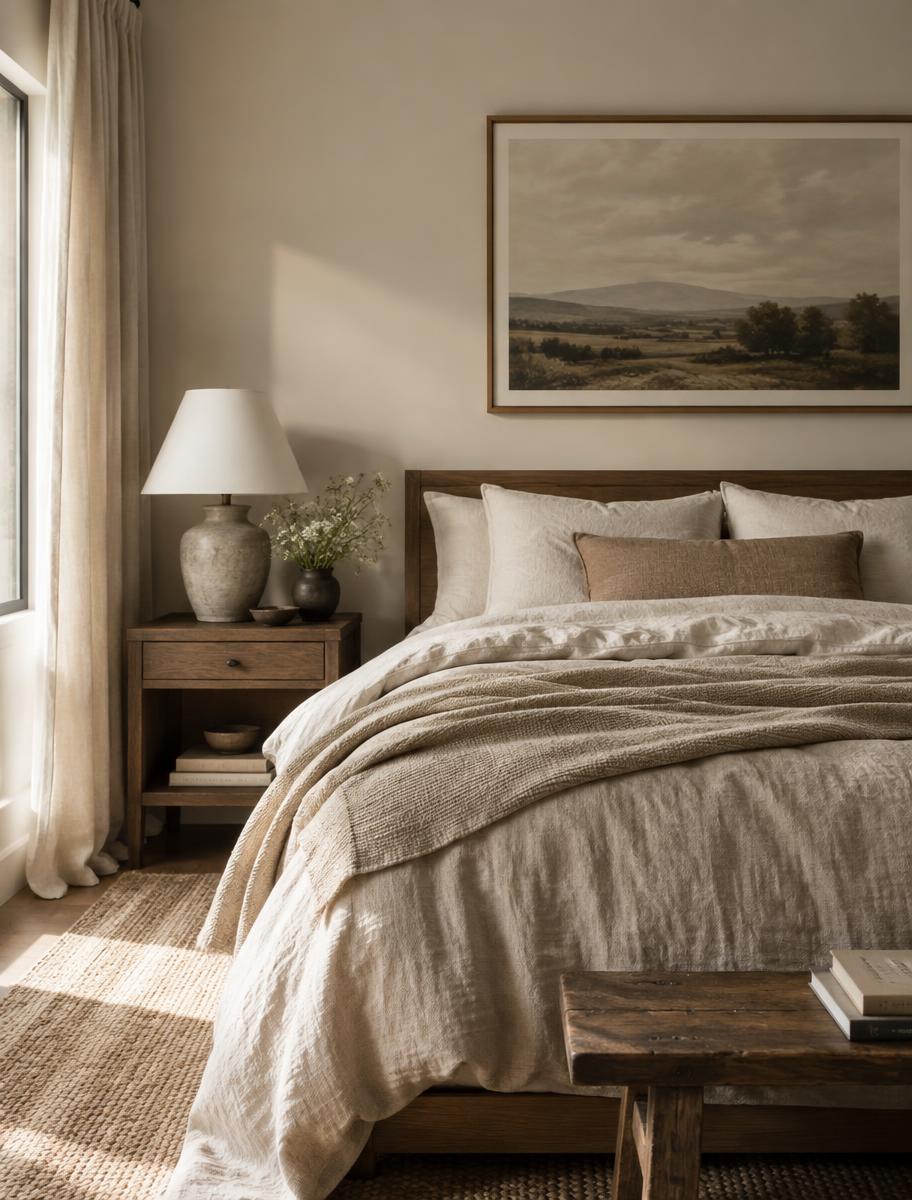
The swap is only the top layer - brushed cotton flannel over the linen sheets you already own.
Colour is part of the warmth, and it costs nothing: a flannel cover or quilt in rust, oatmeal, olive or chocolate brown makes the bed look like November, while the sheets underneath stay cream or white. One warm colour on top is enough.
The order: three thin layers, not one heavy one
One heavy duvet gives you one temperature all night, which is why it fails at 3 a.m. Three thin layers give you three temperatures, each removable on its own. The order is fixed, from the bottom up.
First, the base: the sheets you already have. Linen or cotton sheets stay as the bottom layer. Linen is the better base because it absorbs the dampness of sleep and releases it, so you do not wake clammy - but whatever sheets you slept in all summer will do.
Second, the middle: a light quilt. This is the most useful layer in the stack: warm enough to matter, light enough to fold, sitting between sheet and throw so the bed never has a single heavy moment. In the morning it folds back in one motion; at night it pulls up to your shoulders.
Third, the top: a wool throw at the foot. Wool is dense and grounded where the quilt is light, and it belongs at the foot of the bed, not spread across the whole surface. Folded there, it is weight you can reach for without thinking, and it is the layer that saves the 4 a.m. chill.
Three thin layers, each one removable on its own: linen, quilt, wool.
The test is the 3 a.m. test. You wake warm: push the throw to the foot and the quilt to your waist. You wake cold: pull the quilt up, then the throw over your feet, and you are warm again in a minute without getting out of bed. No layer is ever trapped under another, because each one moves on its own.
The fold that does the work
The quilt earns its place by how it is folded. Fold it in thirds across the bottom third of the bed, where your feet rest: three thicknesses exactly where feet get cold first, while the top stays light and cool. It looks deliberate, too - a folded band of colour across the foot reads as intention, not laundry.
Leave the wool throw folded on top of the quilt. At 4 a.m. one hand pulls it up over your legs, and the quilt is already there underneath. In the morning the same two motions put the bed back together in under a minute.
Folded in thirds across the bottom of the bed, the quilt warms feet and leaves the top cool.
One warning: do not spread the quilt flat across the whole bed. Flat, it becomes a second duvet, and the bed is back to one setting. Folded in thirds at the foot, it is a tool you can adjust - the fold is the difference between layering and just adding more bedding.
Around the bed, not in it
Two small changes sit around the bed rather than in it, and they do more for cold mornings than any extra blanket. Both are cheap and take minutes.
First, the bedside lamp: swap its bulb for a warm 2700K bulb, the amber end of the warm-white range. The last hour before sleep turns soft - the room glows instead of glaring, and the light feels like evening rather than an office. It is the cheapest change in this guide. Keep the lamp low and the overhead light off, and the bedroom starts to feel like a place for sleep an hour before you get into bed.
A warm 2700K bulb in the bedside lamp is the cheapest change in this guide.
Second, the floor beside the bed. At 6 a.m. the coldest moment is the step from a warm bed onto a bare floor, and a small wool runner beside the bed removes it: one flat-weave wool runner, long enough for both feet, along the side you get out of. In our November 9 guide to warm floors, rugs carried the whole room; here the runner gets one line, because its job is only that first step. Slippers beside it do the same work.
A wool runner beside the bed means bare feet never meet a cold floor at 6 a.m.
Those two details are the whole of this section. Anything more - a new rug, a new lamp, a new chair - is a different project, and this guide is deliberately not that project.
What to skip
Skip the heavy single duvet - the one-setting mistake this guide exists to avoid. A thick winter duvet feels generous in the shop and wrong at 3 a.m., when it is either on or off and neither is right.
Skip the matching set. Matching flannel sheets, quilt and throw in the same colour and weave read as a showroom, not a bedroom. The bed should look collected: cream linen, a rust quilt, a cream wool throw, each a different weave in one warm family.
Skip buying anything first: check the linen closet before the shops. Most houses already own a quilt in a cupboard, a wool throw on a sofa, and a flannel cover from last winter. If you truly own none, one light quilt is the single purchase worth making - the middle layer does the most work.
Skip Christmas in this room: no garland, tree or festive bedding is needed to feel like November. Warmth is the season here, not decoration.
Do it in one evening
The swap fits in a single evening, in this order, and then it is done.
- Strip the top layer only. Take the summer cover off and put the flannel cover or the light quilt on instead. Leave the sheets and pillows where they are.
- Build the stack. Sheets as the base, quilt in the middle, wool throw folded at the foot. Fold the quilt in thirds across the bottom third of the bed.
- Change the bulb. One warm 2700K bulb in the bedside lamp, and the overhead light stays off for the evening.
- Lay the runner. One wool runner beside the bed, slippers on it, ready for the morning.
- Stand in the doorway: one warm colour on top, the rest quiet. If your eye lands on something that does not belong, remove it and call the swap done.
Sleep in it for two nights before judging it. The first night you will notice the layers; the second night you will stop noticing them and simply sleep. Thanksgiving is nine days away, and the guests will have their drinks station and their ready rooms - but the host's own sleep is the part of hosting nobody sees, and this one swap takes care of it, in a single evening, with the bedding the house already owns.
Frequently Asked Questions
What is the single best bedding swap for colder November nights?
Change only the top layer - swap the light summer cover for a brushed cotton flannel duvet cover or a light quilt. Keep the sheets you already have; the top layer is the one you feel most at night.
Is layering better than one heavy winter duvet?
Yes, because three thin layers can be adjusted one at a time. Push the throw aside when you wake warm, pull the quilt up when you wake cold - a single heavy duvet only has one setting all night.
How should I fold the quilt on the bed?
Fold it in thirds and lay it across the bottom third of the bed, where your feet rest. That puts three thicknesses where feet get cold first, while the top of the bed stays light and cool.
Do I need to buy new bedding for this swap?
No. Most houses already own a quilt, a wool throw and a flannel cover in a closet or on a sofa. Check there first - the swap is a rearrangement, and one light quilt is the only purchase worth making if you own none.
What bulb should I use in the bedside lamp?
A warm 2700K bulb. It gives an amber, evening glow instead of a bright white light, and it is the cheapest change in this guide.
Written by
Decorating Editor
Rae Bennett is the decorating editor at The Curated Interior, where she writes practical guides to color, texture and warm, collected rooms.
Related Stories
Bedside Styling for a Calmer Bedroom
Keep the nightstand useful and uncluttered with soft light, a few essentials and hidden storage.
Eleanor Vance · Nov 7, 2026
A Guest Room Ready for Holiday Visitors: Small, Warm Touches Before Guests Arrive
Thanksgiving is 24 days away, and the guest room does not need a remodel - just layered bedding a guest can adjust, a clear spot for a suitcase, warm bedside light, and a small basket of essentials they can find without asking.
Rae Bennett · Nov 2, 2026
More From Rooms
A Christmas Dining Table That Stays Warm After Thanksgiving
The changeover weekend's second day belongs to the dining table: one plaid runner, a low evergreen centrepiece, brass candlesticks and cream plates - dressed in one morning, from things the house already owns.
Rae Bennett · Nov 28, 2026
A Warm November Bathroom Shelf: One Surface Before Guests Arrive
Thanksgiving is four days away. One shelf is all a guest will really see - fold the towels one way, set a tray of essentials, and leave a third of it empty.
Rae Bennett · Nov 21, 2026
A Thanksgiving Kids' Table: Small, Warm and Their Own
Thanksgiving is five days away. Give the children a table that is theirs, not a smaller copy of the adults' - kraft paper to draw on, dishes that cannot break, and one simple activity to keep them there.
Rae Bennett · Nov 21, 2026
The Curated Note
A weekly letter on rooms, materials, and the details that make a home feel considered.
One edition each week: a room we're studying, a decorating principle worth borrowing, and the materials we keep returning to. No noise, no selling.
Discussion
Loading comments…